

Does your diet affect your taste buds?
3v3 Vegans, Vegetarians, Omnivores

What’s your favourite food? If you asked your neighbour, they would probably give a different answer to you. That’s because people generally like different foods, and we could guess that this is due to differences in our taste sensitivity - i.e., how easily we can detect certain taste compounds in foods. For example, children actually have more taste buds than adults, which means that they are particularly sensitive to bitterness. When children refuse to eat broccoli and brussels sprouts, it’s not (just) because they’re spoiled brats. In fact, those vegetables taste more bitter to them than adults. Because children are more sensitive to bitterness, they are more likely to dislike bitter foods than adults.

So clearly, taste sensitivity can affect the foods we eat, but researchers in New Zealand wanted to ask: can the foods we eat affect our taste sensitivity? Their hypothesis was that people would be less sensitive to foods that they had more exposure to, and they decided to test this with three groups of people: vegans, vegetarians, and omnivores.
Before we move on, comment below if you consider yourself a vegan, vegetarian, omnivore, or maybe something else? Do you think your ability to detect different tastes is better or worse than your friends? Which taste are you most sensitive to? As a reminder, the five tastes are sweet, salty, bitter, sour, and umami.
So, let’s get into the meat of this study. Researchers recruited 23 vegans, 22 vegetarians, and 35 omnivores for the study and had them taste different concentrations of six different tastes: sweet (sucrose), salty (sodium chloride), bitter (caffeine), sour (citric acid), umami (monosodium glutamate), and metallic (iron II sulphate heptahydrate). Then, a threshold test was conducted to determine the detection threshold for each person. If you would like to learn more about detection thresholds and try to determine your own, this article has a nice explanation and activity.
First, researchers determined six concentrations for each taste compound, and panelists were presented with two samples - one containing the compound, and one just plain water. Then, panelists were asked to choose which sample contained the taste compound. In this way, researchers were able to determine what was the lowest concentration each panelist could detect each taste compound. This was repeated for each taste compound, and the order that the taste compounds were given in was randomized.
What did they find? The figure below shows a PCA biplot of the results showing which taste detection threshold each diet was characterized by.
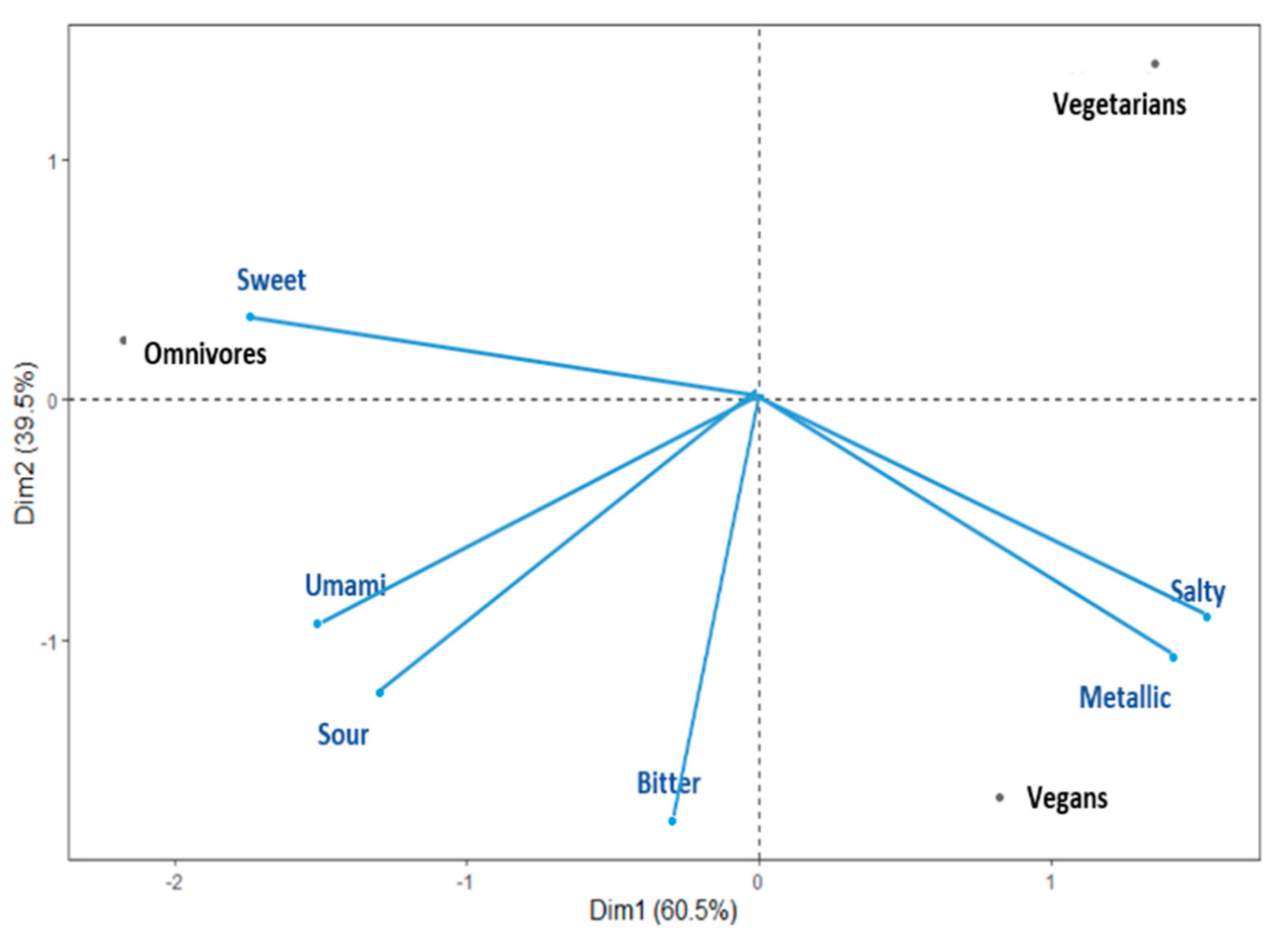
Omnivores had the highest detection threshold to sweetness (meaning that they were the less sensitive to it) and the lowest detection threshold to metallic and salty (meaning that they were more sensitive to those). On the other hand, vegans were less sensitive to metallic and salty taste and more sensitive to sweetness. Finally, vegetarians were the most sensitive to umami, sour, and bitter. Note, that the only instance where these trends were significant was in the case of bitterness, where vegetarians had a significantly lower detection threshold than omnivores and vegans.
Here are some interesting discussion points:
Although omnivores had higher exposure to meat than vegans and vegetarians, they were still the most sensitive to the metallic taste (however, note that this trend was not significant).
This study only tested bitterness in relation to caffeine. There are other types of bitterness (e.g., PROP) that might have produced different results. Notably, a previous study using PROP as the bitter compound found that vegetarians had a lower sensitivity to bitterness.
Dietary data was self reported, and frequency of consumption of different food groups was not tracked. This means that possibly, someone who considered themselves “omnivore” only ate fish. This could have some impact on the results.
Overall, this study was very interesting and brings up the question of how our preferences are determined. If our taste sensitivities can change based on what we eat, then are our taste preferences simply a result of our upbringing and the foods we’re exposed to?

I think I’m most sensitive to sweet stuff. I like my food the same way I like my people - bitter.